Where the Silk Route Meets the Subcontinent: Afghan & Indian Jewelry Fusion
- by Naveen Kumar
Two ancient traditions. One shared love of adornment. And a story that was always meant to be told together.
"Long before borders were drawn on maps, traders, poets, and wanderers carried something more precious than spices along the Silk Route — they carried beauty itself."
Close your eyes and picture a bazaar somewhere between Kabul and Rajasthan. Lapis lazuli the colour of a midnight sky. Bells that ring with every step. Women draped in mirrored fabric, their arms stacked with hammered brass cuffs that catch the desert sun. This is not one place — it is a corridor of culture that flowed for centuries, leaving its mark on everything it touched, especially jewelry.
At HeerMaya, we don't just make jewelry. We make wearable archaeology — pieces that remember where they came from. And nowhere is that memory more vivid than in the beautiful, complex dance between Afghan and Indian tribal aesthetics.
A shared bloodline, written in metal
The connection between Afghan and Indian jewelry is not accidental. It is geographic, historic, and deeply human. The Pashtun tribes of the Afghan border, the Rajput clans of Rajasthan, the nomadic Banjaras who walked both sides — all of them told their stories in silver, brass, and stone. They wore their wealth. They encoded their prayers. They passed their identity from mother to daughter through earrings and pendants, not words.
What emerged over centuries was a visual language that transcends nationality: heavy metalwork, intrinsic geometry, the belief that jewelry is not decoration but protection.

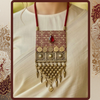
HeerMaya — Embroidered textile pendant with crescent moon details & baroque pearl drops
"In both traditions, jewelry was never merely ornamental. It was armor. It was prayer. It was a woman's autobiography, worn in full public view."
The signature elements of this fusion
These are the design motifs that live at the intersection of both worlds:
|
Kuchi influence Afghan Kuchi nomad jewelry — bold, layered, colorful — uses mirrored glass, coins, and bells. Its spirit echoes in Indian Banjara work. |
Tribal geometry Both traditions favour repeating triangles, chevrons, and hexagons — protective symbols rooted in ancient belief systems. |
|
Lapis & turquoise Afghanistan's most iconic stones travelled south into Indian royal courts and tribal markets alike, becoming common to both vocabularies. |
Brass & copper Where silver was too precious, brass and copper became the metal of the people — warm, malleable, and alive under fire. |
|
Tassel & fringe Movement was intentional — tassels, chains, and fringe created sound and life. Jewelry was meant to be heard as much as seen. |
Textile & thread Afghan embroidered cuffs and Indian mirror-work met in a shared love of fabric-meets-metal jewelry — woven, knotted, alive. |
Why this fusion feels so alive today
There is something deeply modern about this ancient meeting point. In a world saturated with factory-made minimalism, the boldness of Afghan-Indian fusion feels almost rebellious. It says: I know where I come from. I carry it with me.
The global bohemian aesthetic — which has swept fashion from Paris to Sao Paulo — has always drawn from this corridor of craft. But there is a difference between cultural borrowing and cultural understanding. At HeerMaya, we choose understanding. Every piece we make is rooted in a genuine appreciation of the craft tradition it comes from — the techniques, the symbolism, the hands that first shaped these forms.

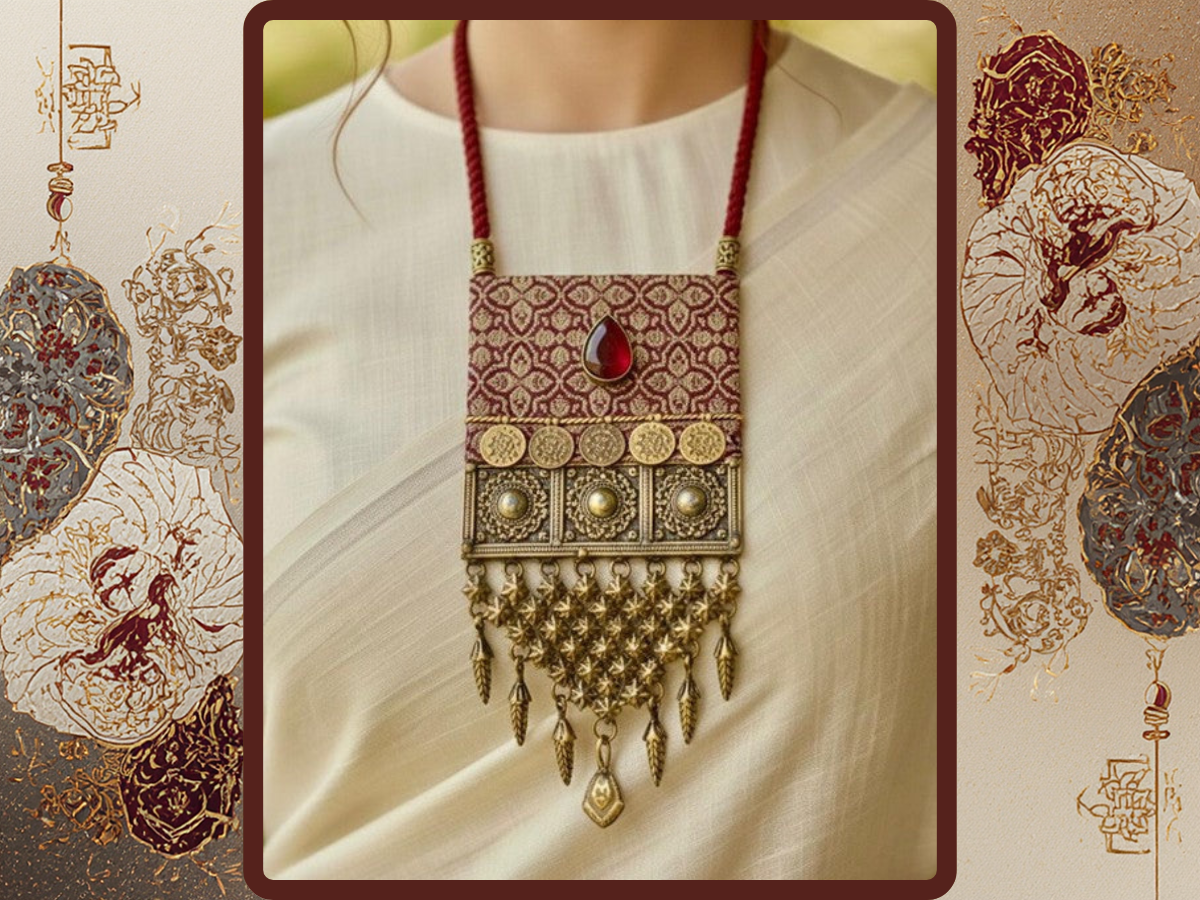
HeerMaya — Kuchi-inspired brocade pendant with antique brass coins, ruby glass stone & layered fringe
"Bohemian isn't a trend for us. It is a lineage. The Silk Route was the original slow fashion movement — beautiful things, made carefully, meant to last generations."
Wearing the fusion — how to style it
The beauty of Afghan-Indian fusion jewelry is that it anchors an outfit rather than accessorises it. A single large Kuchi-inspired pendant can transform a plain white kurta into a statement. A stack of brass bangles with turquoise inlay carries an entire summer dress on its own. These pieces don't shy away — they ask to be the protagonist.
Pair heavy statement earrings with a clean neckline. Layer mismatched rings from different traditions on one hand — that deliberate, collected-over-time look is the whole point. Mix metals freely: brass and copper together are historically accurate and visually rich. And never, ever be afraid to wear too much.
In this tradition, more is not excess. More is abundance. More is a blessing.
The HeerMaya approach
When we design at HeerMaya, we think about the woman who walked both sides of the Khyber Pass.Our answer is in every piece — handcrafted, unhurried, unapologetically bold. Brass, copper, semi-precious stones, textile, shell. Materials that the earth made and human hands shaped. Jewelry that doesn't just look good. Jewelry that means something.
In Conclusion
If this story moved you, you'll find it in every piece in the HeerMaya collection. Each one carries a piece of the Silk Route — waiting for the right person to wear it forward.
Explore the HeerMaya collection at heermaya.com — handcrafted tribal & bohemian jewelry, made with intention.