Afghan Jewelry vs Indian Tribal Jewelry: Nobody Tells You This
- by Naveen Kumar
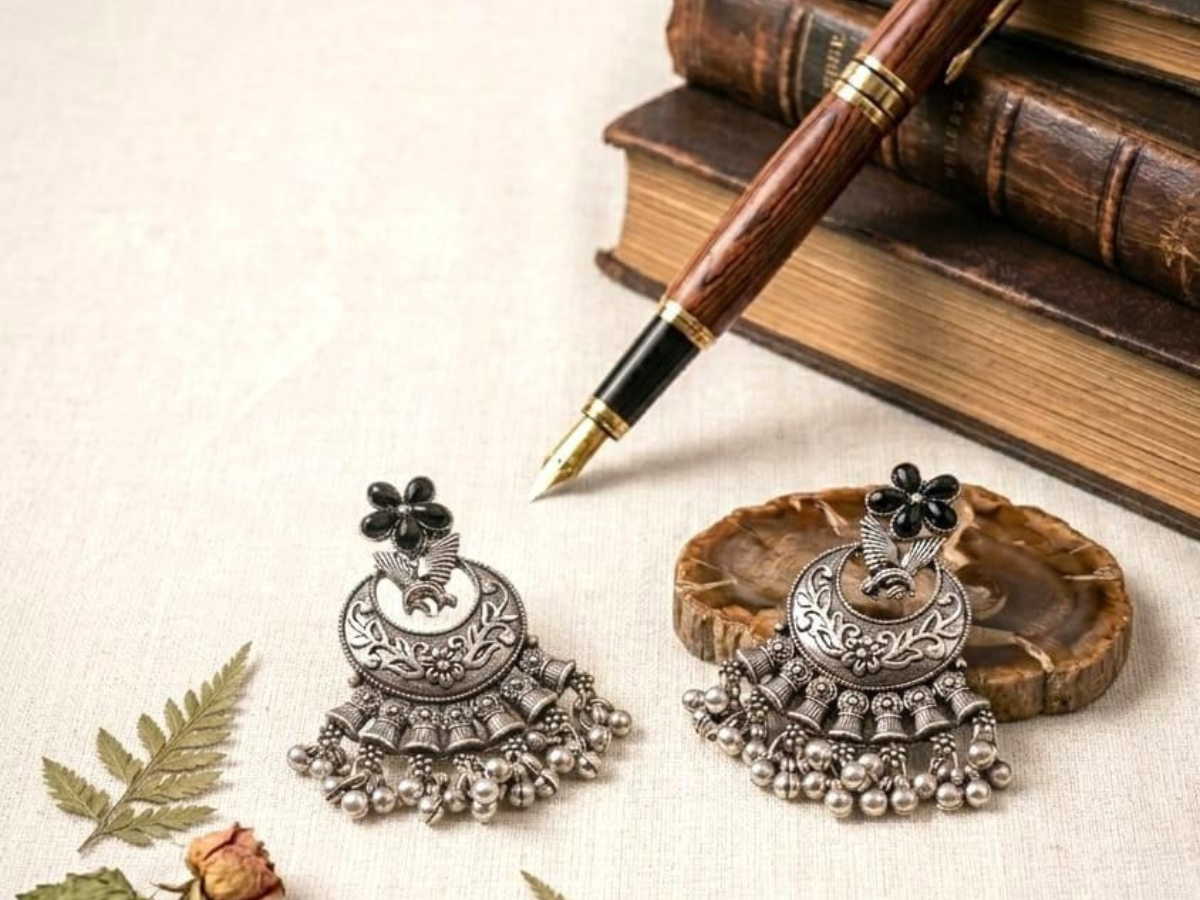
Okay so here's something weird.
You know those people who've been buying ethnic jewellery for years. Who know their oxidised from their antique finish. Who haunt craft markets on weekends. Ask most of them to explain the difference between Afghan jewelry and Indian tribal jewelry and — blank stare. Maybe a guess. Usually wrong.
I get it. I really do. Both feel old. Both feel handmade. Both have that weight to them — not just physical weight, though they're both heavy — but that sense that something happened before this piece reached you. Something real.

HeerMaya's Indian Dhokra tribal necklace — the dancing figures are 4,000 years old.
But here's what nobody tells you: they're not the same tradition. Not even the same continent, basically. Afghan jewelry and Indian tribal jewelry come from completely different places, completely different people — and they were made for completely different reasons.
We sell both at HeerMaya. Have for years. And we get asked one question more than almost anything else — which one. Honestly the answer isn't about the jewelry. It's about which story feels like yours.
Let me explain properly.
1. Where They Actually Come From
Afghan & Turkmen Jewelry — The Silk Route
"Afghan jewelry" is actually a misleading name. More accurate: Silk Route jewelry. Forget Afghanistan as a country for a second. Think borderlands. Think the gaps between countries where nomadic tribes spent generations crossing mountains nobody else wanted to cross. Turkmenistan. Uzbekistan. The Tekke. The Yomut. The Ersari Turkmen clans.
These weren't settled people with shops. They lived on the move. Which means everything they owned had to travel with them.
So where did they keep their savings?
On their bodies. Not metaphorically.
A Turkmen woman's wedding jewelry — those heavy silver pieces, loaded with coins and bells — that was the family's entire wealth. Hammered flat. Hung around a neck. You want to understand why Afghan jewelry is so heavy, so coin-heavy, so loud when it moves? Because these were people who might have to flee across the Hindu Kush at short notice. You don't carry a briefcase across a mountain range in winter. You wear what you can't afford to lose.
That's what the coins are. That's what the bells are. That's why the pieces are substantial — built to survive, not just to look good.

Afghan coin necklace from HeerMaya — portable wealth, not decoration. There's a difference.
Both traditions were made by people who had no word for 'accessory.' For them, jewellery was language.
Indian Tribal Jewelry — Okay, Where Do I Even Start
India is enormous — I keep coming back to this. Go find a Dhokra artisan in Bastar sometime and ask him about the silver smith in Jodhpur. He'll shrug. They're not in the same tradition. They happen to both be Indian and both be extraordinary and that's genuinely where the overlap ends.
No single origin story. No single material. No single anything. India is just too big for that.
The thing they actually share is simpler than people think. These are pieces made by someone who gave a damn. Someone for whom this wasn't just a product.
And weirdly, that's enough to connect them.

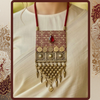
Indian tribal oxidised necklace from HeerMaya — earthy, textured, rooted in the subcontinent.
2. What They're Actually Made Of — And Why It Matters
Afghan Jewelry
Pick up a piece of Afghan jewelry sometime. Go on — if you're ever at a craft fair or a market where they have it. Before you even look at it properly, you'll feel it. The weight is unlike other jewellery. It settles into your hand like it belongs there. Silver — or German silver — and just a lot of it, deliberately, with purpose.
The stones tell you everything though. That deep blue — lapis lazuli — Afghanistan has been mining it for six thousand years. Not 'a long time.' Six thousand. Older than most things humans have built. You see lapis in a piece of jewellery and I'd bet good money it came from Central Asia. India just doesn't use it. Not part of the tradition. It's a giveaway like nothing else.
Carnelian — warm orange-red. Turquoise — that cool blue-green. And coins. Always coins somewhere. Actual coins, or coin-shaped medallions representing portable wealth.
Also bells. Little dangling elements that make noise when she moves. On the Silk Route you wanted people to hear you coming. Silence wasn't the goal.
Quick HeerMaya tip — lapis lazuli basically means Central Asian. India has its own stone traditions and lapis isn't really one of them. Spot it in a piece and you're almost certainly holding something with Silk Route DNA.
Indian Tribal Jewelry — Way Harder to Pin Down
Indian tribal jewelry? Way harder to pin down. And honestly, that's the point.
Dhokra is brass — copper and zinc, cast using methods that are genuinely four thousand years old. Not 'inspired by ancient methods.' The actual same methods.
Oxidised silver is silver that's been deliberately darkened. Treated to look old because the tradition IS old. Once you start wearing it you kind of can't stop — there's something about the way it ages with you.
Glass beads. Thread and fabric woven into pieces. Coral. Shell. Things that come from wherever the maker lived. Afghan jewelry has none of this — no fabric, no thread, no local organic materials. That contrast alone tells you everything.
Afghan jewelry travelled thousands of miles to reach you. Indian tribal jewelry was made in the next village.

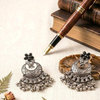
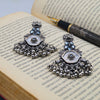
Oxidised tribal earrings from HeerMaya — the imperfect surfaces are the whole point.
3. How They Look — I Mean Actually Look
Afghan Jewelry — It Arrives
I'll tell you exactly what Afghan jewelry does when you put it on. The room shifts. Not dramatically — but someone will look over. Then someone else. It has this quality of demanding attention without asking for it.
Geometric patterns. Coin fringes that catch light and make noise. Heavy symmetrical pendants. Lapis blue against antique silver. Carnelian red. The visual language is architectural — structured, precise, built for impact.

Afghan statement jewelry — bold, geometric, coin-heavy. Announcing itself since 1000 AD.
Afghan jewelry does not whisper. It has been announcing itself for a thousand years and it has no plans to stop.
Indian Tribal Jewelry — It Doesn't Announce. It Just Is.
Indian tribal jewelry doesn't announce. It whispers. Or actually — it doesn't do either. It just... is. It sits there with a peacock motif or an elephant or a dancing woman and it doesn't need your attention because it already knows what it means.
Peacocks. Elephants. Fish. Horses. Sacred symbols. Harvest imagery. There's an organic quality to it — especially Dhokra, where rough surfaces and slightly uneven forms are the whole point. Perfection would ruin it. The imperfection IS what you paid for.
Afghan jewelry says: I am wealth. I am power.
Indian tribal jewelry says: This is who I am. This is what I carry.
And neither one is wrong. They're just — different species, almost.

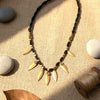
Indian tribal coin necklace from HeerMaya — earthy, story-rich, rooted in the subcontinent.
4. How They're Made — This Part Always Gets People
Afghan Jewelry — The Workshop
Afghan jewelry is silversmithing — real workshop silversmithing. Hammering. Shaping. Soldering. Stone-setting. The kind of craft that doesn't make sense unless you've watched someone do it, and then it makes complete sense.
Something most people don't know — a lot of what you buy as "Afghan jewelry" today is made by Afghan craftsmen living in Jaipur and Delhi. Because of decades of conflict, many artisans left. Their country changed. Their craft didn't. They're still making the exact same pieces their grandfathers made. In a country that isn't theirs. For customers who mostly have no idea this is the story sitting around their neck.
We know. It matters to us.
Dhokra — The Destroyed Mould
Dhokra casting. Okay. I explain this to people and they always do a double-take.
Here's what happens:
The artisan makes a wax model. Coats it in clay. Fires it — the wax melts out, leaving a hollow mould. Pours in molten brass.
Then breaks the mould off.
Destroys it.
Every. Single. Time.
No mould survives the process. The clay gets smashed off. So your piece — the one sitting in your hands — there is no other one like it. The mould that made it is rubble. Your piece isn't.
Not a marketing line. Just how the process works.
5. So — Which One Should You Actually Get?
Go Afghan if...
You're the kind of person who walks into a wedding and wants someone to grab your arm and say where did you GET that. If you want weight and coins and lapis and the actual physical sensation of wearing something ancient. If you're dressing for an occasion that deserves that kind of power. Go Afghan.

HeerMaya's Afghan & Turkmen jewelry — ancient beauty, modern woman. The Silk Route on a neck.
Go Indian tribal if...
You want something rooted in the subcontinent's soul. Dhokra if you want irreplaceable and earthy — a piece that literally cannot be copied. Oxidised silver if you want a daily piece that works with everything and looks better the longer you wear it.
Honestly though?
Buy both. The most interesting jewellery collections hold both traditions — the Silk Route and the subcontinent, side by side. They're not competing — they're telling different stories. You get to decide which one you need today.
We carry both at HeerMaya. Come find yours.
Shop at HeerMaya
→ Afghan & Turkmen Collection: heermaya.com/collections/afghan-turkmen
→ Dhokra Collection: heermaya.com/collections/dhokra
→ Tribal & Handcrafted Collection: https://heermaya.com/collections/tribal-handcrafted
→ Oxidised Collection: heermaya.com/collections/oxidised
Two completely different worlds ended up making jewellery for the same reason.
Because some things are too important to just carry.
They need to be worn.
— HeerMaya
- Posted in:
- Afghan Jewelry
- Afghan statement jewelry
- Dhokra
- HeerMaya
- Indian Tribal Jewelry
- Silk Route jewelry